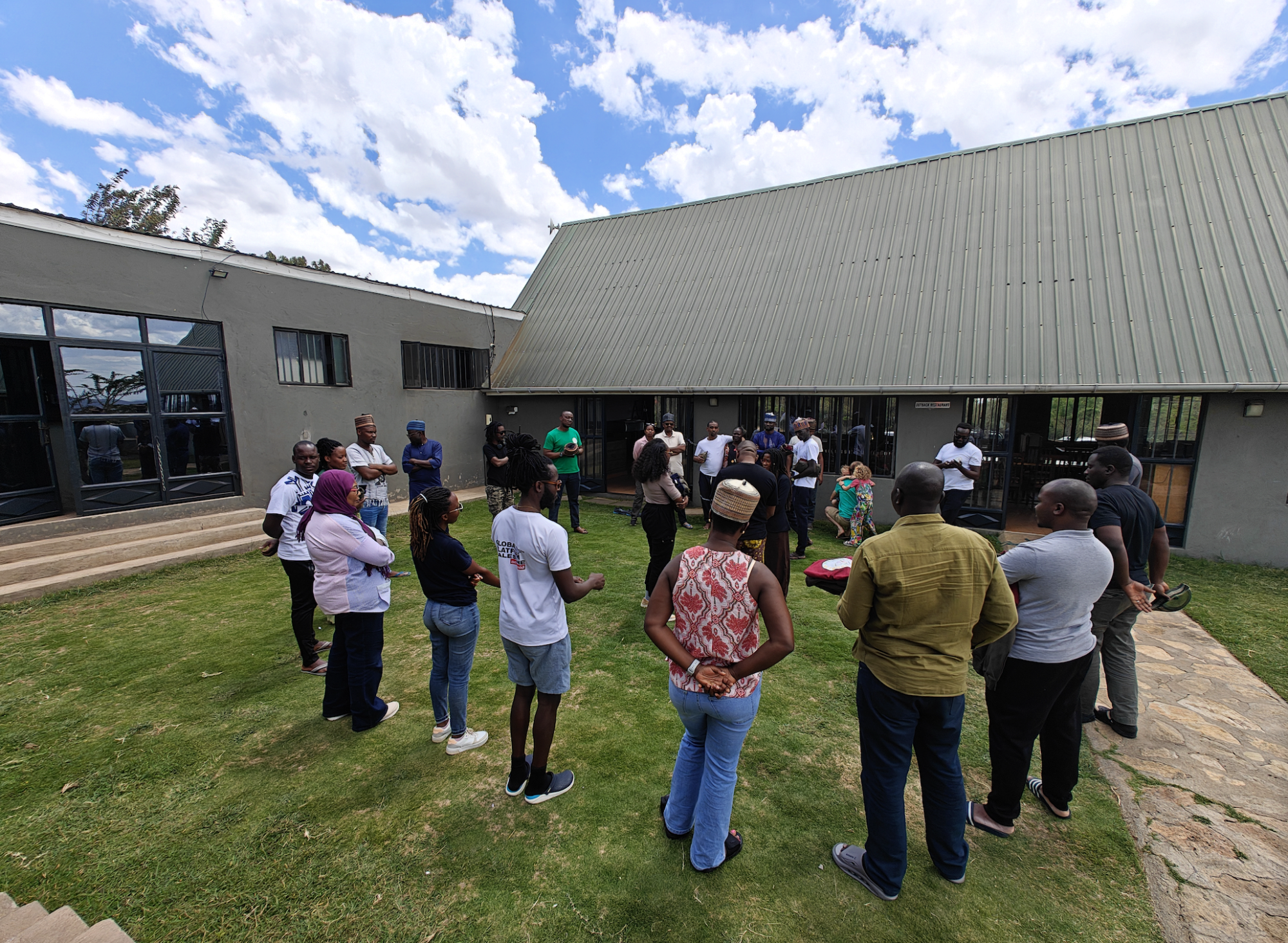
This content was co-authored by Kenneth Chomba, Network Coordinator at the African Coaching Network (ACN); Chris Kif, Co-Director at Sauti Bridge; and Maria Selde, Senior Manager of Strategy, Learning & Impact at Humanity United (HU). HU’s peacebuilding portfolio accompanies ACN’s work as a learning partner. The three authors are connected by their support and evaluation of social movements across Africa, with a focus on understanding relational sovereignty and how it drives meaningful social change.
This blog has been adapted for HU’s audience. The original post was first published on AEA36.
Complexity scientists, systems thinkers, and champions of developmental evaluation have warned us that linear frameworks, like traditional rigid evaluation frameworks—which assume that one step will neatly lead to the next— do not support emergent learning in unpredictable settings. Movements are complex adaptive systems; they keep evolving, meaning they won’t stand still while programs and data are often treated as separate, step-by-step tracks. The work and the meaning of the work happen at the same time, often in the same breath, and a framework built for one doesn’t always serve the other. Here is a story about what that looks like in practice, from inside our own evaluation.
As ACN turns a decade old, we sensed the tempting question every long-running network faces: How do we know if we’ve had impact over the last decade? A conventional review of impact asks for numbers: trainings delivered, campaigns supported, coaches retained. We had those numbers, but they limit us to understanding program outputs only. We are opting to pursue a different question: Did we build the infrastructure to sustain non-violent movement building beyond and without us? ACN is a living system in thirteen countries spanning five languages, a community of people who found each other doing this work long before the network had a name. We knew we had to approach this moment differently.
Instead of a traditional evaluation framework, we used a framework called Roots, Branches, and Fruits (RBF), which treats a movement’s life the way a living thing grows rather than the way a project gets delivered. Within this framework, “roots” asks what let our coaches tell the truth about what they were living through, often for the first time. “Branches” asks where that truth traveled once it was safe to speak, whether into new alliances or new rooms we hadn’t planned to enter. “Fruits” asks what became possible only when both roots and branches were sustained together.
This process surfaced the wins, but also the emotional toll and labor we’ve experienced as an organization. We started calling this the Resilience Tax, the toll that is absorbed —quietly and often unobserved by whoever holds a network together—through repression, funding cycles, and grief.
Lesson Learned: Naming the Hard Truth is What Makes the Next Step Possible
RBF has a name for the part of the work where a movement must sit with truth honestly before it can move on: the Bitter Harvest. For us, that meant admitting things a funder report never asks about: the burnout carried by a small core of people, the cost of holding a family-style network together for a decade. Naming the hard truth honestly didn’t slow us down; it allowed us to imagine our next ten years with clarity.
In peacebuilding evaluation and research in conflict-affected environments, practitioners have long grappled with how standard metrics miss the invisible labor of safety, trauma-informed accompaniment, and social cohesion. Organizations and networks operating in contexts of fragility know that quantitative outputs (like training delivered or documents produced) frequently mask the profound human infrastructure required just to keep a community breathing.
The Shift From Tools to Mindset
Evaluating in unstable conditions requires a shift in mindset over new tools. And more often, the work does not fit neatly within a program because of such fragility. This is therefore an invitation to consider understanding change as a spiral movement – where the untidy work and its meaning belong together.
So, we leave you with a question: how can evaluation capture the wins as well as the cost it took to get there, beyond the money and the budget lines?
Rad Resources