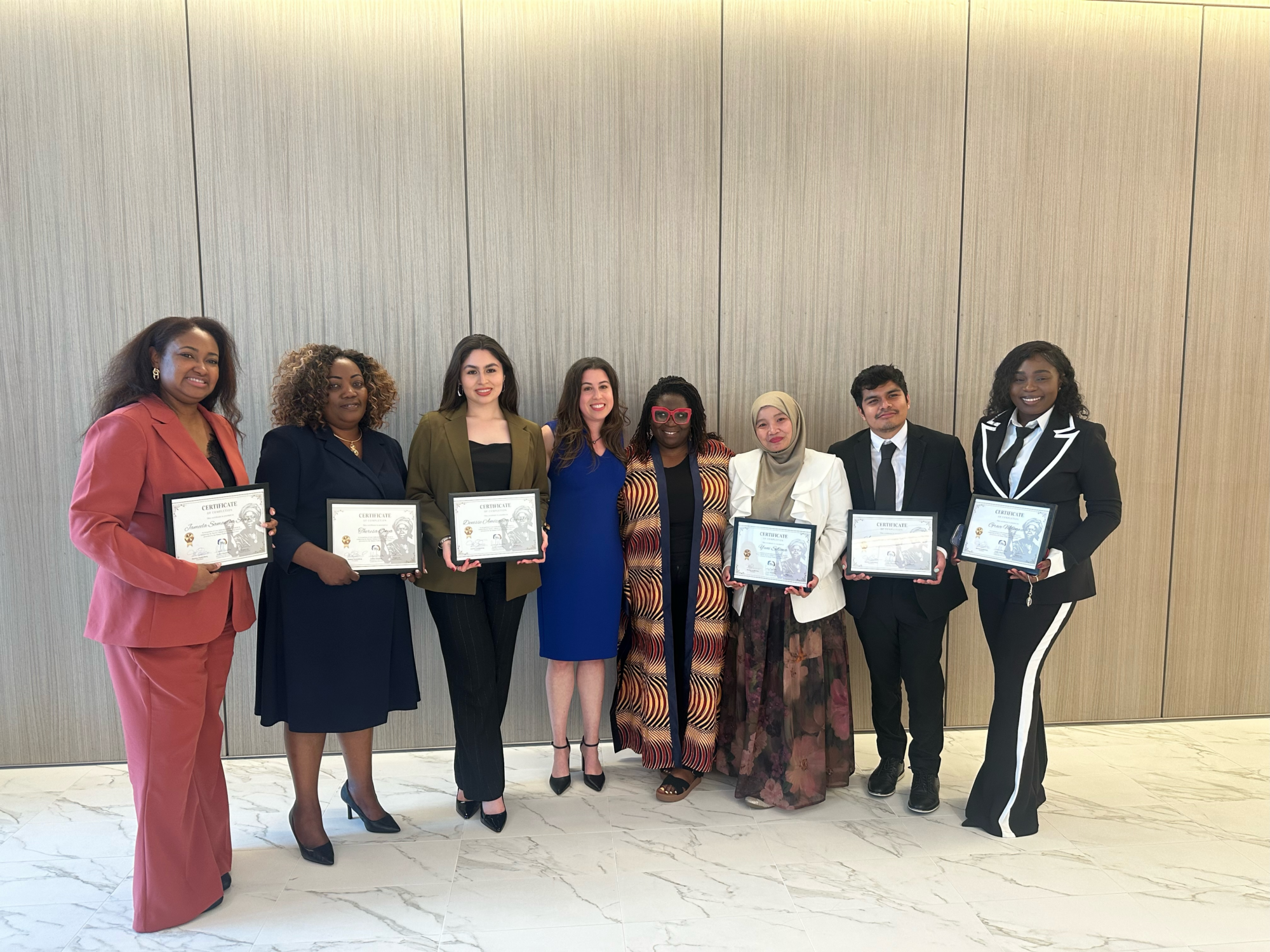
Two years ago, the Human Trafficking Legal Center launched the Harriet Tubman Fellowship, a two-year program providing a cohort of labor trafficking survivor-leaders with access to resources to build their leadership and professional skills. As the inaugural cohort’s fellowship period comes to an end and the Center welcomes a new class of Fellows, Humanity United spoke with three graduate Fellows, Anthony, J. Samantha, and Yuni, to reflect on their time in the program.
HU: What expectations did you have coming into this fellowship, and how were they met or challenged?
J. Samantha: When I first came across the fellowship, what really stood out to me was its vision of building survivor leaders in different spaces and sectors. I was especially excited about the opportunity to pursue my passion for cybersecurity while also developing my public speaking and leadership skills.
Looking back, those expectations were absolutely met. The leadership and communication training gave me confidence and prepared me to use my voice in ways I hadn’t before. I’m currently studying cybersecurity, and I’m excited to apply both my technical skills and what I learned through the fellowship to create systems that help prevent trafficking and better support survivors in the future.
Anthony: I think my expectations coming into the fellowship were mainly that this was going to be an educational opportunity where I could continue my career and my education, but I think it went beyond that because I was able to be connected to a mentor, I was able to get to know the other fellows, and I feel like we have connected very well and support each other. I was brought into this new community that feels very supportive and came with a lot of opportunities, not just to support my career and education, but also my personal life, my understanding of what it means to be in this movement when you’re a survivor, and how to take that experience and show people who I am but also educate them.
Yuni: My expectation at first was about the stipend only. I thought it was just a general scholarship program where they give you a stipend and leave you alone. But it was amazing and beyond my expectations. I met so many people, and Evelyn [Chumbow] and the staff kept in touch with us, kept checking in about our studies and what was going on. Compared to what I’ve seen with other programs, this fellowship program is better about keeping fellows together; it’s about more than the stipend.
HU: What is something you accomplished during these two years that you never thought you could do?
Yuni: It was my dream to continue my education and get a Master’s degree since 2014, and I finally graduated last December. On my graduation day, it blew my mind that I had done it after 10 years. I have no words to describe how grateful I am to have reached my goal because of this fellowship. The other thing is having joined a fellowship with the United Nations. Because of this program, I felt more confident to try out more opportunities and try to apply for other fellowships, and I was able to finish that last May.
J. Samantha: I think the biggest surprise for me was how much my confidence grew. It’s something I carry with me into every space I walk into now. Before the fellowship, I never imagined I’d be sitting down with policymakers and having the opportunity to contribute to conversations that could help shape policies and systems for other survivors.
Anthony: One of the things that I accomplished that I never thought I would is the amount of public speaking engagements that I feel more comfortable doing. As a shy person who is reserved and has been isolated for so long, it feels really good to be able to share my experience but also learn about the topic of human trafficking through research. I’ve had so many opportunities, and I feel those have come because of the fellowship.
HU: Can you tell us about someone you met or engaged with during the Fellowship (for example, another fellow, a policymaker, or someone else) who changed how you think about your work or your future?
Anthony: I think for me it would be my mentor, she has been really amazing. I work at a nonprofit, and she has a lot of experience with development and how to be a leader in a nonprofit. I feel like there has been a lot of support with that mentor connection, which is something I didn’t expect from the fellowship. She has become really close to me, beyond how she supports me with my job, the relationship has also become really personal. There are day to day challenges in life, and we talk about those, and she is a great coach and support on how to handle different dynamics in my life. We are even going beyond the fellowship time, and she has agreed to continue being my mentor because we have built this relationship, and I think she wants to see where life takes me.
J. Samantha: My mentor had the biggest impact on me during this fellowship. Having that one-on-one support, accountability, and guidance really helped me excel professionally and academically, especially while balancing a full-time job, pursuing my cybersecurity degree, and running my business. My mentor’s support and wisdom were foundational to my growth, and having someone who consistently believed in me gave me the confidence to pursue opportunities I never thought were possible.
Yuni: For my side, I think it’s Evelyn. Evelyn inspires me to use my experience to help others. I am a teacher, and I teach a lot of immigrants so I want to use my own experience and journey to teach my students. Before meeting Evelyn, I would just go to class and teach, but after meeting her and joining this fellowship, I started to think, ‘why don’t I use my experience in my lesson plan like Evelyn does to support us, to inspire us?’
HU: What are you carrying forward beyond your time in the program?
Yuni: I think I’m carrying forward the skills. I really love the way that the program prepared us for public speaking, negotiation, and how to advocate. This fellowship has opened new doors for me with networking and my personal growth. I now feel more confident in speaking up and advocating for other survivors, for my students, for my sisters, and in my own life. I feel more confident, this program really changed my entire life.
Anthony: I think what I’m carrying with me is how hard it is to be in this movement but also how meaningful it becomes when you have so much passion for it. I feel like the fellowship has taught me skills that I feel that I can apply when it comes to advocacy or working in a nonprofit. I have grown, and now I’m getting more opportunities to be part of the leadership team of my organization. I’m part of the decision-making process for our program, and being in that space makes me feel like all the work that I’ve done is being compensated, that my voice is heard. I’m also going to carry all the connections, all the support, and relationships with the other fellows. Even though it’s hard, and it may be harder at this time, it’s meaningful, and it creates a sense of unity between us.
J. Samantha: One of the things I’m carrying forward is learning to trust my instincts. My mentor helped me realize that I have good instincts and that I don’t have to constantly second-guess myself. Having someone genuinely believe in you builds your confidence in a way that only authentic support can, and that’s something I’ll carry with me long after the fellowship.
HU: What advice would you give to the new class of fellows?
J. Samantha: I would tell the new fellows to be fully present in every part of the experience. Try to learn from every win, every obstacle, and every moment of the journey because it all has something to teach you.
I would also encourage them to be intentional about rest. I’m guilty of always pushing myself, but I’ve learned that rest and hard work go hand in hand. Don’t underestimate the value of slowing down and taking care of yourself, because you’ll get so much more out of the experience when you do.
Yuni: I would say stay focused because the fellowship is limited in time, even though the support and love is unlimited. Take all the opportunities and advantages from the fellowship, and when you’re done, you’ll see something new in your life.
Anthony: Take the opportunity to learn from the fellowship, there are a lot of skills taught by Evelyn and other people who have been doing this work for so long. Open your heart to it because it becomes very personalized, very meaningful. There have been times where we’ve all been crying together or celebrating together, so this is a time to be vulnerable, discover yourself, and move forward from there. That is needed to heal and to advance.