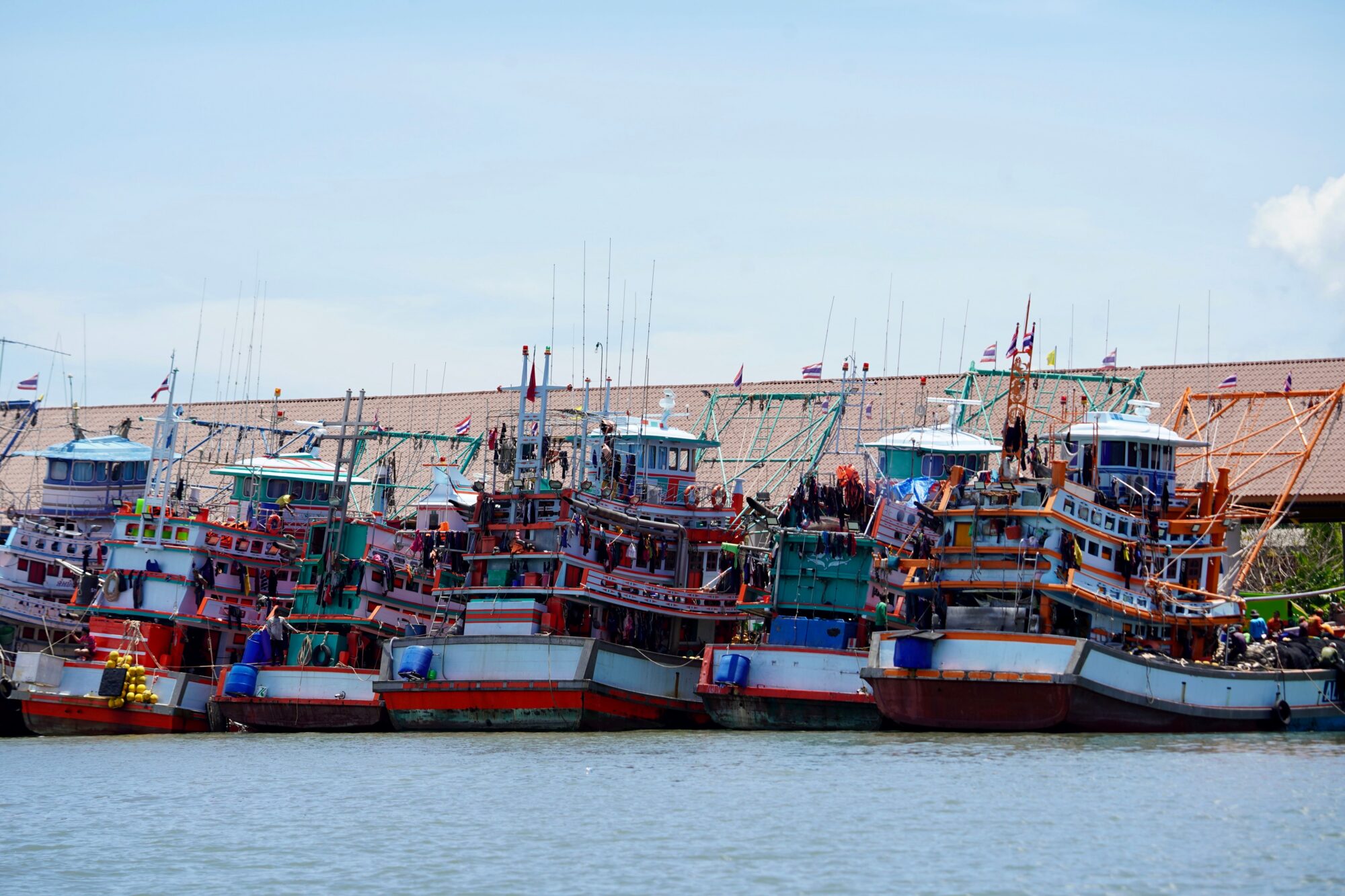
A recent 10-year story of systemic change by PolicySolve, commissioned by Humanity United and the Freedom Fund, makes sense of the complex story of how, why, and under what conditions system-level changes emerged in the Thai seafood industry.
Overall, our goal was to gain insights into how and why the system changed, what influenced the change along the way, and what changes are durable or fragile to disruption. This positions us to replicate key approaches that may work in other systems, as well as continue to protect and advance change in Thailand and the region. Notably, the study is not focused on philanthropic strategies and their impact. Instead, the philanthropic contribution to change is one part of a larger story centered on how change is really happening.
The study drew on over 60 stakeholders’ insights, including workers themselves, and 130 reports, examining reforms from a global to local level that collectively sought to address forced labor and human trafficking in Thailand’s seafood sector. The study uses a methodology that rigorously analyzes the causes of change over time, both discrete events and long-term patterns.
PolicySolve found that from 2014 to 2024, this industry underwent measurable legal and regulatory transformation following investigations by journalists, international NGOs, Thai civil society organizations, and the United States Trafficking in Persons report. In 2014, these investigations revealed the seafood sector was rife with forced labor and human trafficking due to an unregulated supply chain, lack of governmental oversight, and the demand for the mass production of cheap seafood by retailers. At this point in time, more than 80% of workers in Thailand’s seafood sector reported never feeling “free.”
By 2024, the study found significant yet uneven reforms in Thailand’s legal and regulatory systems, with points of major change stemming from the occurrence of multiple external crises combined with global and local pressure and the capacity among many different actors to influence how change happened. The report cited a variety of prevalence studies, including a 2022 UN Network on Migration study that found a shift for workers, with less violence, more effective use of contracts, better access to identity documents, and higher wages. While it remains evident that some of the issues of forced labor in the Thai seafood and fishing industries are unresolved, the data demonstrates that the system has changed in fundamental ways that are unlikely to revert, including through legal and regulatory structures and practices; shifts in business practices; and capacity and skills within Thai civil society and among workers who are organizing to hold Thai businesses and the government accountable.
The causal analysis in the report identified these changes as the result of a set of conditions that were foundational throughout the ten years:
1) There was public and common understanding of the systemic nature of the problem
2) Stakeholders across sectors generally agreed on a shared solution set
3) The many sectors and stakeholders held self-interested, distinct, and stable motivations
4) INGOs (International Non-Governmental Organizations) and Thai CSOs (Thai Civil Society Organizations) had the capacity to support and demand change
5) Cross-sector collaboration was the norm
6) Export-oriented businesses underwent major reform, yet market competition and power imbalances between buyers and suppliers weakened long-term change
7) Key historical, cultural, and political dynamics in Thailand remained constant
Change, grounded in these seven conditions, occurred through a set of processes that embedded and flowed over time. These include such things as variability in the external pressure on the Thai government from international governments and media coverage; the entrance and exit of leaders with the personality, passion and position to influence change; and the inconsistency of how changes were implemented, with some reforms more fully implemented than others and some remaining performative rather than transformative.
Additionally, the study found that philanthropy has played a critical, often strategic role in advancing change within the system. Some philanthropic partners prioritized ongoing capacity for change at the global level, including within industry, while others prioritized civil society internationally and in Thailand. In addition to funding critical actors, the study also found that Humanity United funded short-term, high-impact interventions during critical moments with clear evidence of systemic impact, including the early media investigations that helped to create visibility and the common definition of the problem, and through later interventions that put pressure on the global private sector at a critical moment in time.
The findings also reinforced and added nuance to a long held belief by Humanity United and the Freedom Fund: ongoing collaboration and capacity among in-country civil society, workers, and international civil society can directly influence systemic change. The findings indicate that the impact of civil society varied depending on the stage of change the system was in, with civil society’s role in supporting workers directly remaining critical throughout, but other roles like legal advocacy and worker organizing playing a particularly critical role once a strong legal framework was adopted by Thailand.
Learn more in the full 10-year retrospective report and accompanying executive summary.